By mid-2026, enterprise AI has moved decisively from experimental chatbots to 'Agentic AI'. Organizations are now deploying multi-agent systems that autonomously collaborate to execute complex, multi-step workflows. This post breaks down the technical and strategic shifts driving this new era.
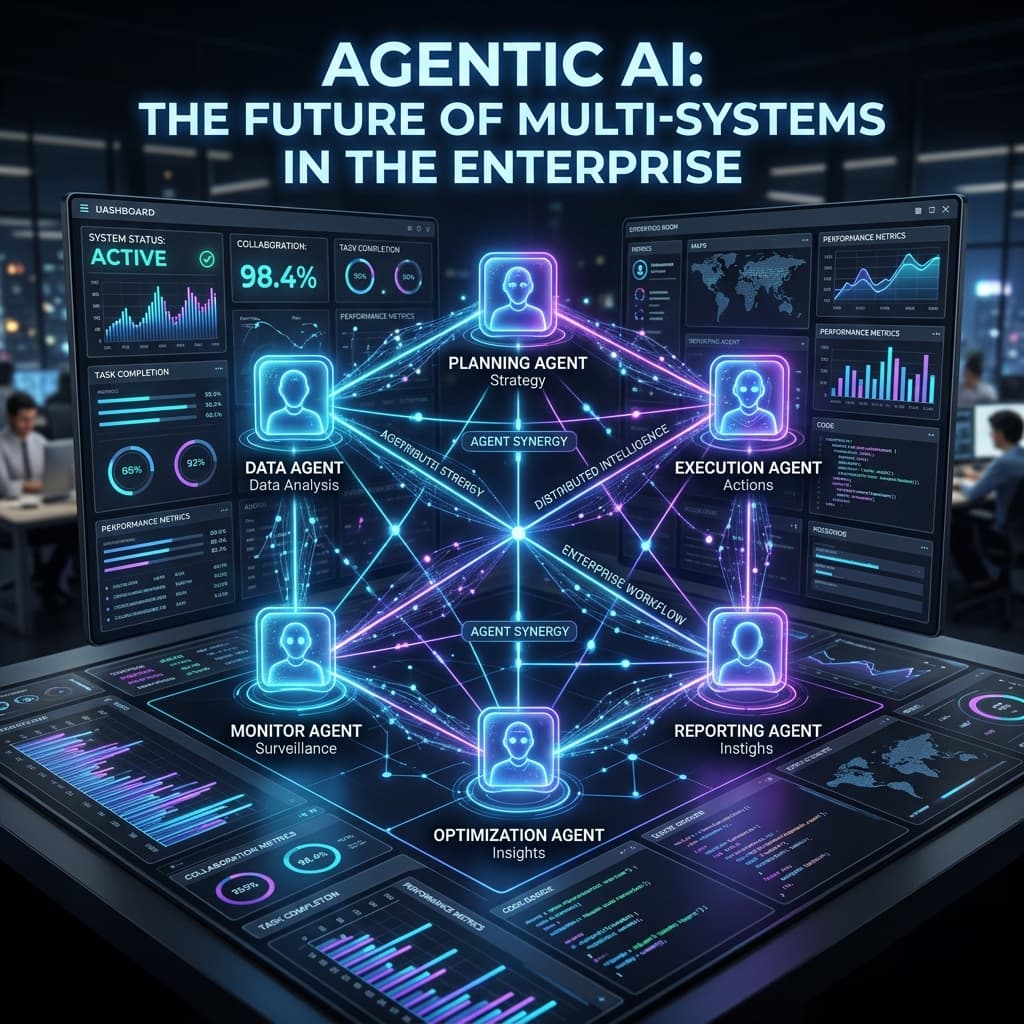
If there is one phrase defining the tech landscape in June 2026, it is Agentic AI. For the past two years, companies have been obsessed with "chatting" with LLMs. But the novelty of basic RAG (Retrieval-Augmented Generation) and simple Q&A bots has worn off.
Today, enterprise leaders and engineers are focusing on something much more powerful: multi-agent systems where specialized AI models act autonomously, coordinate with each other, and execute multi-step workflows without human intervention.
The Death of the "Copilot" Era
The "copilot" model—where an AI sits beside a human and waits for instructions—is rapidly evolving. According to recent reports across the industry, CIOs are shifting their budgets from standalone chatbots toward true AI Integration & Automation.
Why? Because enterprise workflows are rarely single-step. Consider a customer refund process: 1. One system needs to verify the purchase. 2. Another checks inventory or digital usage. 3. A third calculates the prorated refund. 4. A final system executes the API call to Stripe or PayPal.
In an Agentic AI architecture, instead of a human manually moving data between these steps, a "Manager Agent" orchestrates the workflow, delegating tasks to highly specialized sub-agents.
The Tools Driving the Multi-Agent Revolution
The infrastructure to support these autonomous actors has matured incredibly fast this year. Frameworks that were experimental in 2024 have become production-grade stalwarts in 2026:
* LangGraph & AutoGen: The open-source community, particularly LangChain, has perfected graph-based agent orchestration, allowing for cyclic workflows and stateful memory. * Model Context Protocol (MCP): The rapid adoption of MCP has standardized how AI agents access external tools and data, effectively acting as the USB-C for AI capabilities. * Specialized Foundation Models: We are no longer relying on one massive, expensive model for everything. Teams are utilizing smaller, fast models (like the open-source Nemotron or Llama series) for routing and logic, while reserving heavy hitters from OpenAI or Anthropic only for complex reasoning tasks.
The New Focus: IT Fundamentals & Governance
With AI now taking autonomous actions—like modifying databases or sending emails to clients—the focus has shifted away from simply "making the model smarter" and toward robust IT fundamentals.
As an engineer, my day-to-day work (which you can read more about on my About page) has shifted heavily towards building guardrails. If a multi-agent system is processing financial transactions, how do we ensure it doesn't hallucinate a zero?
This requires: * Human-in-the-Loop (HITL) Checkpoints: Requiring human approval only for high-stakes decisions, while automating the 95% of tedious prep work. * Immutable Audit Logs: Tracing exactly which agent made a decision, what data it accessed, and why it took that action. * Least Privilege Access: Using strict IAM roles so a data-analysis agent cannot accidentally trigger a database wipe.
The Bottom Line
The transition to Agentic AI isn't just a software update; it's a fundamental reimagining of enterprise operations. The companies winning in 2026 aren't the ones with the smartest single chatbot—they are the ones with the most robust, secure, and coordinated *team* of AI agents.
If you are looking to architecture a custom, secure multi-agent system for your business, feel free to reach out for a consultation.